


Let’s be real for a second. When was the last time you actually sent a referral link to a friend because you wanted a recruit-a-friend badge or a handful of virtual currency? Honestly? Most of those programs feel like digital chores. We’re asking players to do our marketing for us in exchange for some virtual pocket change, and frankly, I think players can see through this thin veil. They don’t want to be your unpaid sales reps.
But… players are still talking about games. They’re still dragging their friends into lobbies. The linear world of “Player A invites Player B” still exists, and I plan on writing about that at some point. In this piece, I wanted to focus on something more chaotic and interesting: the rise of the “Aspirational Economy”.
This type of thinking requires us not only to examine what a player needs, but who they want to become. Most of my observations are with a focus on publishing to those under 21 years old, and largely stem from the teachings of Rene Girard’s Mimetic Theory, and conversations with my colleague Chris Tom, who made me think more deeply about this topic.
A crisis of credibility and death of the single “influencer” tastemaker
If you’re marketing a game to young adults, it’s gotten a lot harder recently. This generation was raised in an era of disclosed placements and sponsored streams. They’ve grown to be skeptical. Therefore, they want to see that an influencer genuinely loves the game, avidly supports it, and is committed to it for a prolonged period. They also expect multiple influencers and creators to be doing the same thing. They rarely view a single influencer’s endorsement as a seal of quality.
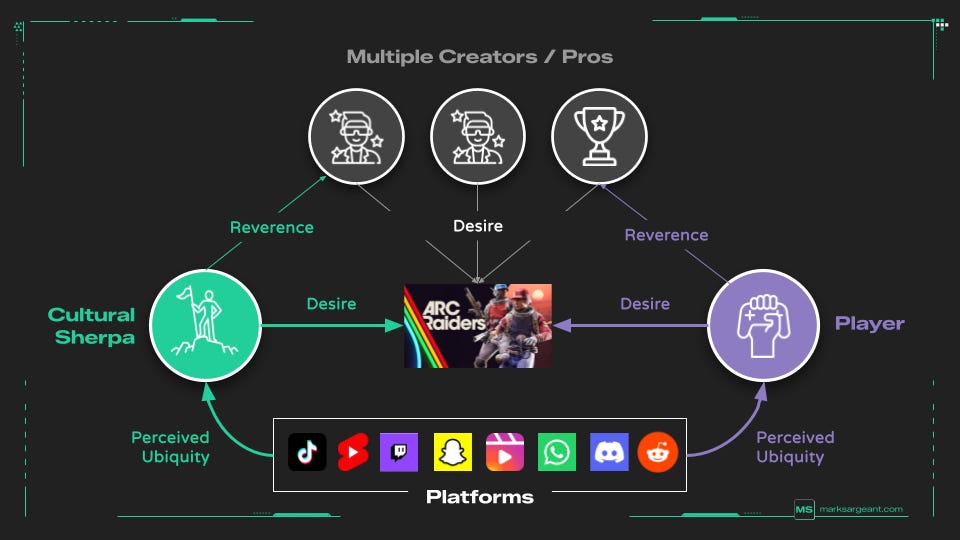
One “god-tier” influencer alone isn’t enough to hoist and keep a game in the spotlight. Players expect a sense of perceived ubiquity. Where a game is only real… if it is socially validated across their entire ecosystem. Players need to see it on TikTok, it needs to pop up on the recommended YouTube feed, in the chatter of class/school, in the WhatsApp chats, on Reddit/forums, and in other places that players tend to congregate. Shroud, the popular FPS streamer, struggled with trying to individually build momentum for his own title, Spectre Divide. Even with him passionately pushing the game, without perceived ubiquity, the game never really took off. The product’s perceived gameplay gaps likely didn’t help its case either. I’ve observed a sharp decline in the power of any one single influencer — there are exceptions of course, but the general pattern is that players are less trusting of a single voice these days.
What I do think still goes along way is validation from the peer-group. These modern gaming peer groups are predominantly influenced by two key forces: a tastemaker within the social group (“The Cultural Sherpa”), and content on social media platforms (“Algorithmic Discovery”). Let’s explore each of these in turn.
Cultural sherpas and their role as internal mediators
If the single tastemaker is dead, who takes their place? It’s the internal mediator. In Girard’s framework, an Internal Mediator is someone you look up to who is physically and socially close to you. In gaming terms, this is the pioneering tastemaker of the Discord server or group chat (“The Cultural Sherpa”). They aren’t professional influencers with millions of followers; but they are the friends who always seem to know what’s going on in the gaming world, and what could be a promising new game for their various gaming circles to try.
For the under 21 demographic, the Sherpa is the primary architect of desire. They provide permission to play. While a pro stream might make a game look cool, it’s the Sherpa who makes it real for the group. They’re the ones that will get the group to download the game and give it a go.
The underpinning psychology is that players, particularly those that are still young and growing into the world, do not truly know what they want. Instead, they imitate the desire of others. While we won't readily admit it, we rarely desire something for its inherent, intrinsic value. Rather, we assign value to games because we see other people wanting to play them. Instead of a straight line between a player and the game, desire is triangular, involving a player, their Sherpa, and the game itself.
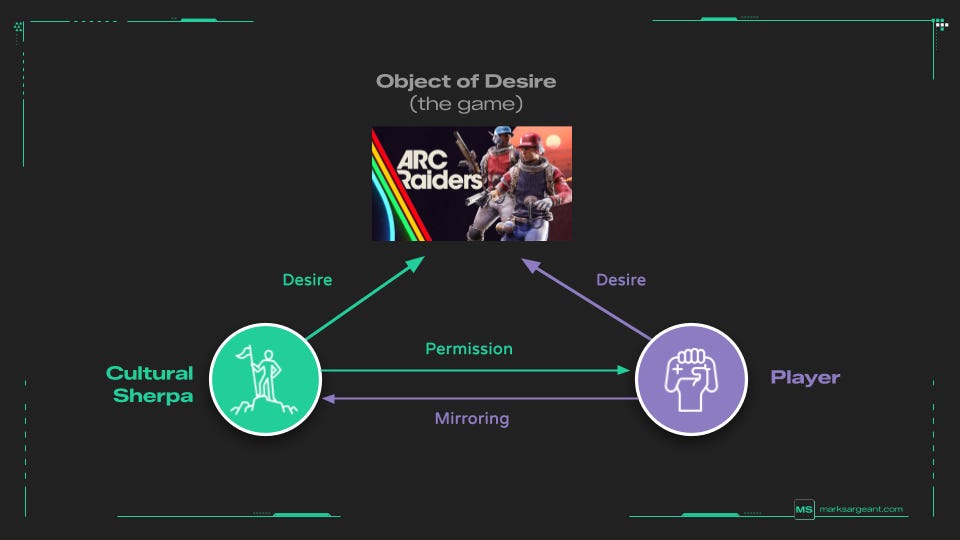
But being the Sherpa comes with a massive amount of reputational risk. Every time a Sherpa says, “Hey, we should all get on this,” they are making a social bet. They’re putting their necks out. If the game is a banger, their status as a tastemaker goes up. If the game is cringe or a ghost town, they lose social capital.
Because of this risk, the Sherpa is rarely a true early adopter in total isolation. They are looking for a safety net. They need to feel that if they lead their friends into this new world, they won’t be left standing there alone. If they’re going to climb that mountain, they’re gonna want to know that it’s going to be worth it. Perceived ubiquity is what gives them this confidence. If your game is perceived as having velocity, durability, and watchability, particularly through easy-to-share short form content, then the algorithm and buzz on all the platforms gives them the “cover fire” they need to convince the group.
Algorithms as a cog in the wheel of Discovery
We’ve had algorithms recommend new games to us for a while now. I still check out my recommended games on Steam religiously. But for younger players in the West, my belief is that the algorithms that they’re paying attention to are more likely to be Shorts, Reels, Twitch, Snapchat, and, Reddit, TikTok. I have a somewhat cynical view of these social media platforms. They are deeply and covertly rogue. And it’s not accidental; it’s by design. Behind their veils, they’re sophisticated desire-generating machines.
The Sherpa often gets pulled into these desire generators and searches for that one game that stops the endless scroll. Most of the time, they’re trawling through scraps of content. Short, 15 or 30 second clips, often with some exaggerated aspect of a game. I call them scraps, since they’re often in Decontextualized format, which is basically this idea that the content has been remixed, or selectively cut down, often with the original content and creator obfuscated, or presented in a “reaction video” style format. Only the good parts are shown, to incite the maximum emotional response possible. Typically, something really funny, confusing, scary, hype, controversial, or angry. The identity of the person creating the content is often secondary to the payoff that the Sherpa is looking to see on the screen.
Just watch the following clips and see if you can piece things together. They’re all designed to play into the fundamentals of human emotion…
For a game to satisfy the Sherpa’s need for Perceived Ubiquity, the game needs to be seen as being socially salient. When the Sherpa sees these scraps popping up across multiple platforms, the algorithm is essentially validating the bet. It signals to the Sherpa that the game is socially recognized by the zeitgeist.
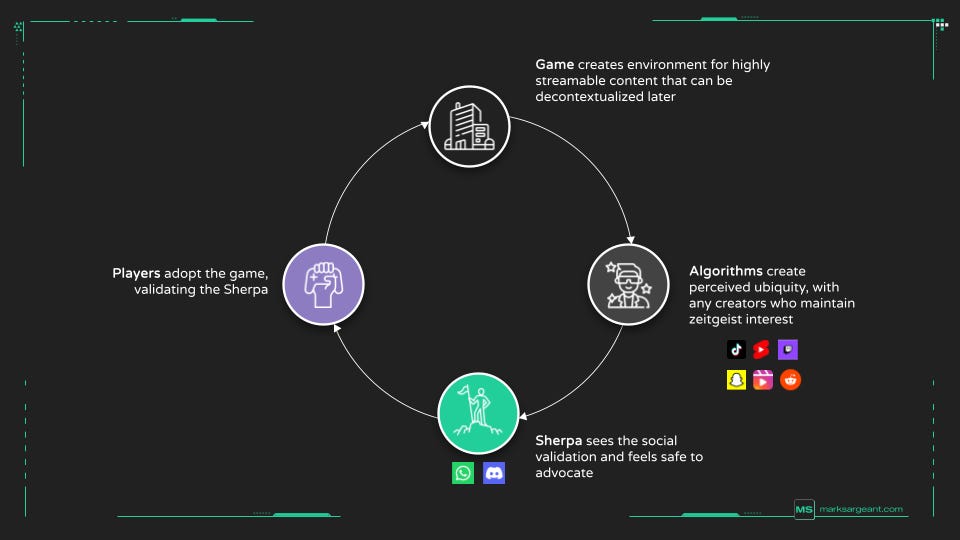
Arc Raiders demonstrates this phenomenon quite well. Clips of Arc are super readable, you don’t have to even play to get a sense for what is going on. Extraction as a genre tends to have a lot of boring, inventory management type moments. It has always surprised me why folks enjoy watching the long-form content on Twitch for games like Escape from Tarkov. By contrast, in a decontextualized short form clip, you can bottle up the magic of hours worth of gameplay into seconds. Extraction tends to have some of the highest highs in gaming, so it’s no surprise that content creators are up chasing this audience, with Arc’s rising salience and inherent watchability acting as a beacon for those who want to create content.
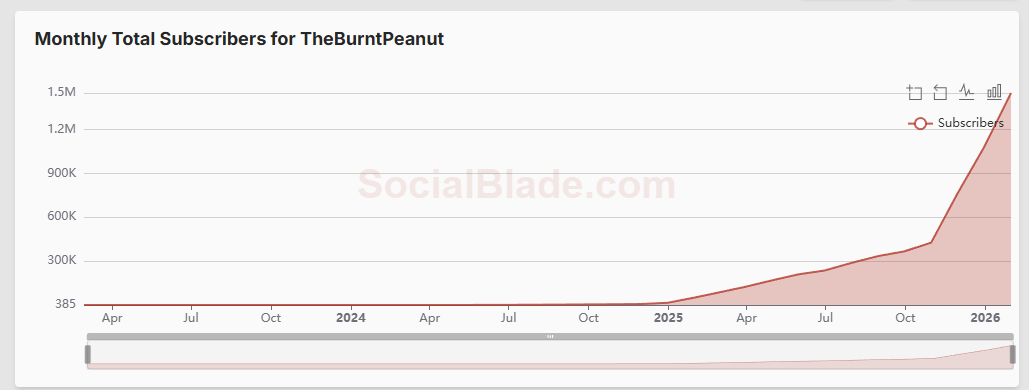
Here’s the unorthodox observation I’ve had lately. Viewers aren’t the ones chasing streamers. It’s the streamers who are chasing the audience. TheBurntPeanut’s meteoric rise has a lot to do with what the algorithms recommend. His decontextualized clips are all extremely popular. The algorithmic platforms don’t care what content you’re consuming. As long as you’re doom scrolling. They want to place content that will keep you hooked. TheBurntPeanut realizes that Arc as a game provides an excellent foundation for emotionally resonant, highly shareable clips. He combines this with a ridiculous personification as a peanut and a light hearted, fun, exaggerated approach to streaming. The algorithms love him. They realize he’s able to capture the attention of the broader zeitgeist, and therefore keep surfacing his content to players who will consume it.
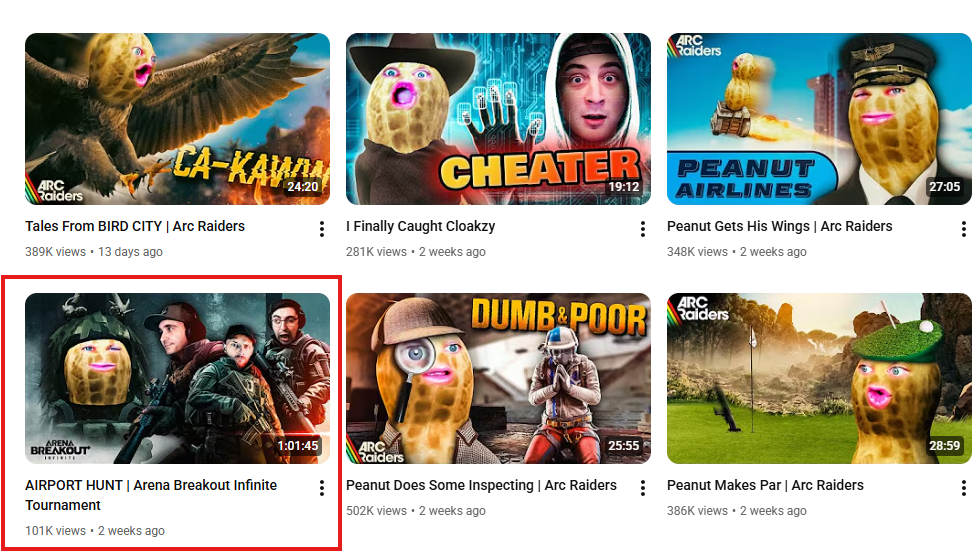
The side effect is that Peanut is now audience trapped. If he tries to start making content for other games, or anything else that doesn’t reflect Arc’s rise in the zeitgeist, then the algorithms will penalize him and tank his performance. When he tries to stream another game (e.g. Arena Breakout in the image above), the algorithm penalizes this behavior. It realizes the content is not what his audience wants to see, and is less effective at retaining users, so it shows it less to them. This is why it’s extremely difficult for new games to “win over” dedicated gaming streamers. Their monetary livelihoods are often inextricably linked to the health of the gaming community they cast their original banner on. This is why folks like Tyler1 will never stop streaming League of Legends - he is chained to the algorithm. This is also why Roblox influencers rarely leave the platform, since once you’re in the Roblox part of YouTube, it’s very difficult to leave.
I spoke a lot about the Sherpa’s consumption of the algorithms content, but what the regular player in a peer group or squad consumes also matters. They might not actively seek this information with the same level of vigor, but they are recipients and light consumers of this content. Both sides depend on the algorithm to validate a game’s perceived ubiquity. If you see a peanut shaped Vtuber shouting about a game incessantly multiple times throughout a day, and then be told by your Sherpa friend to try it at school, on Discord, and with multiple clips on WhatsApp, that’s a pretty hot lead that you’ll likely act on.
The potential of becoming someone
Once the algorithm has created the smoke (ubiquity) and the Sherpa has pointed to the fire (permission), then you ask yourself: “Why stay?”. This is where we need to examine the core of human desire. Borrowing from Girard, we recognize that humans don’t just want things; we want to be people. Marketing can’t just be about meeting unmet needs, but also fundamentally about selling stories, identities, and entire lifestyles. This is what is called the Aspirational Economy. The primary currency is potential. A game’s role is to provide this potential.
There are multiple forms of this, but the one that I tend to gravitate towards stems from Girard’s theory of Mimetic Desire. Where he argues that we don’t choose our own desires. We copy them from others. We don’t want to reach Challenger in League of Legends for the sake of it, but because our role models - the Sherpas, the creators, the “cool” players - want it. We want to feel what they feel.
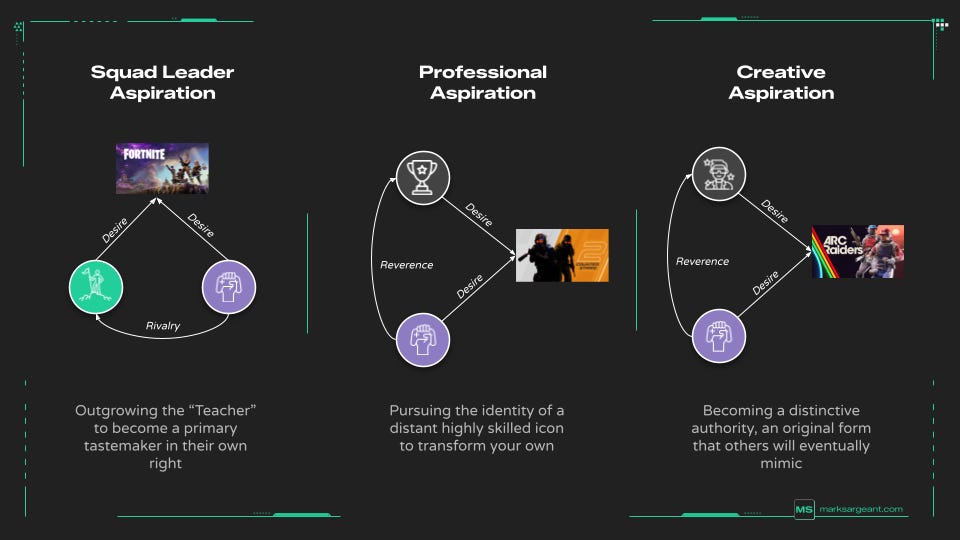
This is what fuels a player’s desire. For some, it’s moving from being a “mimic” in a social group to being the Sherpa in a different social circle. These players want to be highly skilled at and knowledgeable about a socially salient game - so they can become the person that friends look up to. They may even want to eclipse the original Sherpa who brought them in, which gets into the concept of Mimetic Rivalry. This is where two players desire the same, non-shareable status, leading them to compete against one another. This effect is why I think social gaming groups often splinter. It’s not strictly a bad thing for the game though, since someone leaving a group to become a Sherpa in a different group is likely a net positive for the game overall.
For others, it’s about becoming the god on the mountain. While players know they likely won’t become the next Faker, the goat of League of Legends, the potential that they could be is the engine that keeps the ladder populated. This is similar to the acting industry in Hollywood. The industry doesn’t survive on the 1% who are stars, but on the 99% who believe there is a clear, meritocratic path from “nobody” to “somebody”. Competitive games that create clear scouting grounds, open qualifiers, and a series of grassroots and feeder systems tend to benefit from this form of aspiration. If these paths start to feel closed, fixed, or unfair, the potential evaporates, and the mimetic engine stalls.
The last form of potential is to be the creative authority. The BurntPeanut approach. Where a player doesn’t want to be the best player in the world, but just the most entertaining person playing this game. Tyler1 in League of Legends leaned into this same aspiration. Jyxnzi from Clash Royale too. They’re relatively good players, but they’re entertainers first and foremost. In a world of clones, players want to be the original form that others mimic. When games keep the same set of influencers as the face of the game for long enough, you end up calcifying the landscape. Then, new players don’t build this creative authority aspiration.
Games should try to inject volatility into the system such that calcification doesn’t occur. The algorithm will work against you though, since as we discussed before, they don’t really care who is keeping players engaged, as long as they keep them scrolling. The established creators tend to have an advantage and will be hard to unseat.
The danger of an uneven playing field and the need to inject volatility
Looking at long-standing competitive games, I see this trend towards calcification. This happens when the top of the hierarchy - the same pros and creators - remains unchanged for years. While stability can be a sign for a healthy professional scene, it can inadvertently signal to new players that all the seats are taken. If the people at the top are being provided unfair structural advantages, like differentiated access to developers, this takes away potential from players. The objective is for all players to perceive an equal baseline of potential – even if absolute parity is not always possible, or even prudent, to maintain.
This applies even to just core fans of a game. If they feel their status is “fixed”, they will become protective of the way the game is played. Becoming more and more an insular group, rather than a welcoming committee. This is the feeling you often get when you boot up a competitive game that’s been around for decades: Call of Duty, DOTA, League, etc. My rationale is that these games do not inject enough volatility into the system, which would otherwise function as a decalcifier. A lot of their veteran players expect the game to be played a very specific way, and the developers have only introduced incremental changes over a long period due to a fear of disrupting the delicate balance. So new players who are coming in are expected to follow rank, or be called out for not following the standard way to play.
Games that are able to refresh potential and inject volatility tend to get the Aspirational Economy roaring again. When games like Overwatch drop 5 new heroes in a single patch, this creates a massive step change in the meta. Deadlock is benefiting from this same volatility right now too. Even the most established Sherpas need to reprove their mastery, Creators get another chance at convincing the algorithm they’re content is worth pushing, and there is a fresh opportunity for new players to jump in during a period of re-learning. Another way would be through highlighting a broader range of voices - not just the existing “Kings” of your game - but rising creators and neighborhood experts, ideally through your own channels, away from the cruel patterns of the algorithm.
The overcorrection is that you inject too much volatility. The fundamental hook of the Aspirational Economy is the promise of becoming someone. If a player invests hundreds of hours to attain a certain status - becoming a “lore expert” or “top affliction warlock” - they are essentially buying into a specific identity. If volatility is too high (e.g. the meta shifts so violently that last month’s expertise is now worthless), that identity loses its value. The currency of potential can’t devalue too quickly, there must be some durability to the status. Without some level of stability, there is no “Being” worth chasing.
In summary, the idea is that a game should be perceived as fair for all, and if things start to get too stable, try to inject volatility that gives Aspiration a quick refresh. But critically, there needs to be an equilibrium here. You want to shake the tree to see what new fruit falls, but you have to leave the tree standing long enough for the players to climb it.
Algorithms are junk food; touch some grass
Finally, we must recognize the limits of the digital scroll. Desires that emanate from the digital space alone are Thin desires. They are fleeting, mimetic, and easily broken by the next shiny object. This is why you often see players cycle through all the various friendslop games (Lethal Company, REPO, etc). To build a game that lasts decades, you have to create Thick desires. These are the deep, intrinsic motivations that come from mastery and real human connection.
Successful games are able to move beyond the screen and into the real world. Whether it is local grassroots tournaments, large esport events, merch that you can buy in a store, fan meetups, watch parties, LAN parties, movies, shows, and broader pop culture, these physical touchpoints help to reinforce a player’s identity. There’s nothing quite like attending your first League of Legends World Final.
To be clear, this isn’t about advertising esports. That’s certainly a pinnacle experience. What’s more important are the regular, more frequent touchpoints, the ones happening IRL in the player’s local areas. It is much harder to walk away from a community that knows your name, recognizes your mastery, and expects you to show up Tuesday nights. Games should be building an ecosystem around the game that enables this type of identity reinforcement to happen, ideally in a scalable manner.
A game is just a software product. But if you can transform the game into a lived culture. Then the identities that players have been chasing start to reinforce. When you see others with that same aspiration, it reminds you of why you picked this path in the first place.
Parting thoughts: shaping aspiration
If there is one takeaway I’d like to end with: you should try to be a form of cultural engineer. This means being able to build an ecosystem that: respects the Sherpa’s reputation, feeds the algorithm’s hunger for scraps, and most importantly creates and protects the player’s potential to become someone.
Don’t just ask what players will do in the game. Ask who they will be.

If this resonated, or annoyed you in a useful way, I’ll be writing more about defining your audience, positioning your game, solving for advocacy, AI trends for publishers, and games distribution more broadly.
This is cool. Appreciate the write-up -- definitely a "be careful what you wish for" aspect to the algorithms. Let's see what the coming years bring...
One of my favorite books is Ana Andjelic’s “The Business of Aspiration: How Social, Cultural, and Environmental Capital Changes Brands.” I’m not sure if you’ve read it, but your piece captures its spirit and translates it into the language of the games industry.
Your piece was an especially insightful read for me, particularly after spending the whole weekend thinking about this topic.