


There are over 3.6 billion gamers on earth. This isn’t a number that’s slowing down either. What used to be designed and enjoyed by a very specific demographic is now a common pastime, enjoyed by all shapes and sizes.
With all the potential people a game could reach, it’s important to be clear about the audience you’re actually trying to reach. Both in terms of your ideal player/muse, but also adjacent players.
I believe audience understanding should be holistic. This involves building a complete understanding of their identity, how to reach and find them, their psyche and underlying needs and desires, their broader lifestyle & cultural context, as well as their relationship to your studio and portfolio.
This is what I call the “5Rs Framework”.
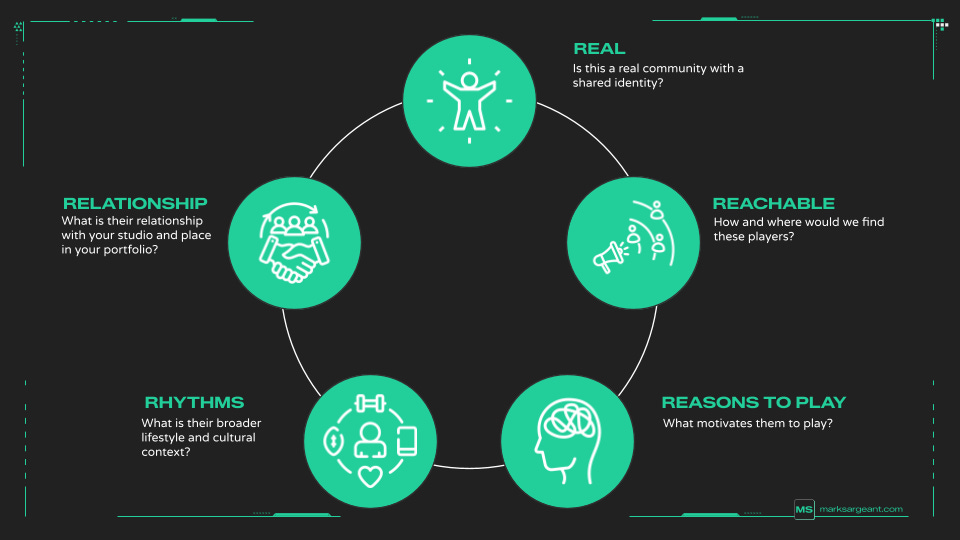
Real: Is this a real community with a shared identity?
If you can’t name, find, or meet a person who meets your audience definition, they’re probably not real. And you need to adjust. The razors could be too broad, too narrow, or the combination of audience lenses that you’re using aren’t quite right.
Serving a game in an existing genre typically makes this a bit easier, since players often describe themselves using genre labels, monikers such as “FPS player”, or “MOBA player”. If players don’t describe themselves in ways that you’re ascribing to them, then that’s also problematic. For example, if you’re trying to serve “animal loving gamers”, essentially players who love animals and also love games, but this audience doesn’t refer to themselves in that way at all, then you ought to revisit. We’re looking for a community that exists whether your game is there or not. They have their own jokes, their own insider language, and their own way of looking at the world.
Another way to understand if this audience is real is trying to list a list of streamers, influencers, or celebrities who fit with your audience definition. While they might not be a perfect fit, if there is a loose fit, then the task of substantiating the audience becomes a lot easier. The goal is to be able to validate that this audience actually exists in the real world.
You’ll want to understand how they talk about themselves and their relationship to games in general. Do they even describe themselves as gamers? Is gaming core to their identity? Or is something that they keep concealed. Audiences where there is an established shared identity, and players are effectively already aggregated are going to be easier to study. If this audience doesn’t yet identify themselves in this way, and hasn’t met other players who fit this definition, then you’ll have the harder task of having to aggregate them in the first place. Disaggregated audiences are harder to distribute games too.
Since games often remain in development for a long time, you’ll also want to assess the general stability of this identity. Is it stable (e.g. Tactical FPS players), fluid (e.g. VR gamer), growing (e.g. Roblox Battlegrounds player) or in decline (e.g. RTS players)? My perspective is that stable, or growing identities are more attractive, and require less developer intervention to course correct. Fluid identities are riskier, but let you shape expectations from the ground up. Declining identities may only have short runways, but one upside is there may be few competitors.
Crucially, the dev team needs to be able to identify with this identity. It’s ideal if many of them share this identity. And if not, at least relate to this identity, through potentially being an older version of this same player, or having close friends/family who fit this identity. Development becomes a lot easier when you can just look in the mirror.
Reachable: How and where would we find these players?
It’s one thing to know who your audience is; it’s another thing entirely to actually find them in the wild. You can have the most vibrant community of players in mind, but if they’re hiding in a private Discord server, subdivided across many different games, and difficult to move over, then your marketing budget is going to have a very bad time.
Think of it like trying to find a specific friend at a massive music festival. If you don’t know which stage they’re at or what they’re wearing, you’re just wandering around hoping to find them in the wild. You might get some help from algorithmic storefronts, like Steam, but most of the time, you’re on your own.
The first thing to check is simple: where do these people congregate? The answer can’t just be “social media”. It’s likely to be much more fragmented and nuanced. Are there in a specific subreddit debating the meta of a 10-year old RPG? A digital forum dedicated to others with that interest? Do they all meetup at a once a year event where the most dedicated fans show up? Or are they part of a Discord where the devs of a rival game talk to them? If your team already identifies with this audience, this becomes a lot easier – you just know, since you’re likely already in those circles. But otherwise, it’s like detective work. You’re looking for signals. Maybe they all follow the same micro influencer who specializes in “stress-free” cozy games. Maybe they’re the types to spend hours in the comments section of TikTok for Roblox. If you can find the figurative neighborhood they live in, you’re halfway there.
How people find games has also changed. “Googling it” is often a second order activity; a thing you do after you’ve already discovered a game. Most of the time, the recommendation is coming from a close friend, or a cultural sherpa. Streamers still have some sway, but which ones help you find your audience best? What unintended audiences come with those streamers? You have to figure out who the gatekeepers are. Once you know who they trust, you can stop shouting into the void and start having actual conversations..
It is important to both understand the different sources of influences. That is, what are all the different ways a player could learn about your game. But equally important is to understand the strength of each of the sources, specifically for your player. You could then try to visualize this, in a sources of influence map, like the below, to get a sense for what your publishing approach should prioritize.
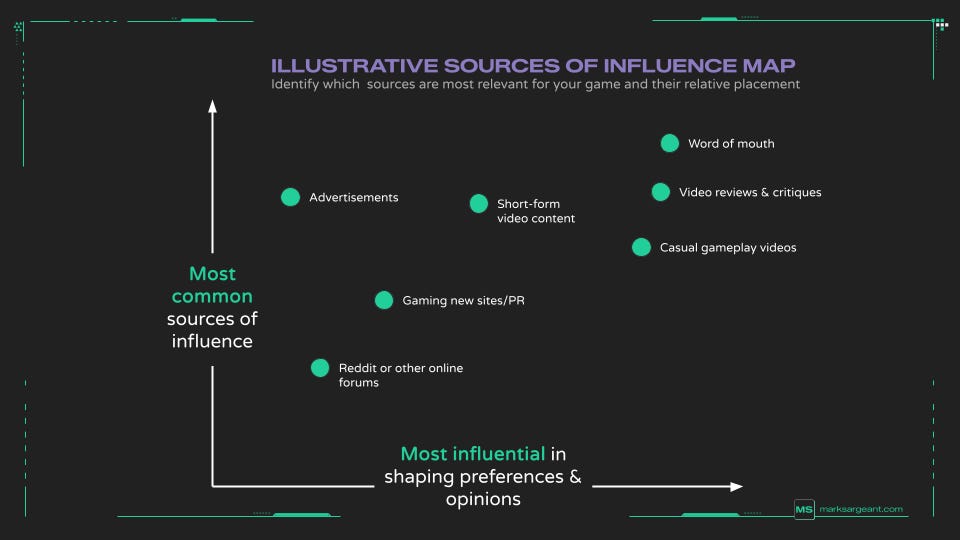
A lot of this gets easier if you understand what existing games, genres, and creators this audience already follows. If your game is trying to position itself for the city building sandbox player, then it’s likely that this player has played or is playing Cities Skyline. And therefore, they likely follow any game from Paradox Interactive or Hooded Horse. They probably have notifications turned on for creators like Keralis - who is basically the king of “look how pretty this bush looks” - or City Planner Plays, who brings actual civil engineering logic to the digital table. These players tend to only play on PC and expect a deep modding community, so you’d need to figure out how to meet that need as well.
Understanding if they’re reachable also involves examining what might prevent them from trialing your game. Barriers are likely to be audience or game specific, but to generalize, will likely comprise of some combination of the following: lack of social proof, niche appeal/position, perceived time commitment required, hardware limitations/spec, accessibility requirements, high backlog of superior games, price point, genre fatigue or lack of novelty, perceived complexity or learning curve, poor reputation or reviews, art style/theme/setting mismatch, or just not having the basic awareness of your title. I believe that it is critical that you understand what are the biggest barriers to trial for each of your audience segments, and start building bridges over those gaps long before a game is launched.
Reasons to play: What motivates them to play?
Often most importantly, you need to understand what motivates them to play in the first play. Richard Bartle created an initial classification called the Bartle Types. There are many derivations and other similar frameworks that stem from psychographic clusters. I tend to look at these, but also pair them with a few other angles, as follows.
Every game has its magic moment - the specific feeling players are constantly chasing. For the city builder crowd, this might be the ant farm moment. It’s the feeling of zooming out after three hours of detailed and creative work and seeing the tiny digital citizens using the bus route you painstakingly just optimized. It’s a sense of total, benevolent control. But for a horror fan, the reason to play might be the safe scare moment, that adrenaline spike you get when you know you’re being hunted, but you’re actually tucked under a duvet with a bag of chips.
Identifying what the core loop of joy is fundamental. Are they chasing the flow state where the world just disappears? Are they looking for social status by showing off a rare piece of loot? Or is it purely catharsis - the simple pleasure of smashing things after a long day?
Sometimes the strongest reason to play your game is that existing options (your competitors) are frustrating or under-serving your player. If your favorite shooter is overrun with toxic lobbies and predatory battle passes, that’s going to eventually run its toll. Marvel Rivals was able to capitalize on a frustrated pool of Overwatch players, and launched just as frustration was starting to reach a tipping point.
Understanding what makes the game worth it is also really important. We’ve all had that feeling of finishing a game and thinking, “Well, that was a waste of twenty hours.” To avoid that, you have to understand what makes an experience meaningful to your specific audience. For some, it’s a narrative gut-punch that stays with them for weeks. For others, it’s finally beating a boss that’s been kicking their teeth in for three days - that feeling of Perseverance and Mastery. It’s helpful to map these out, are players motivated by Achievement (stats, ranks, completionism), or Immersion (story, roleplaying, atmosphere). Once you know their DNA, you can stop marketing features and start marketing feelings.
Finally, what are the goals that they want to pursue? It’s easy to assume everyone wants to win, but that’s rarely the whole story. In a sandbox game, the goal might be “make it look pretty”. In a survival game, the goal might be “build a base so secure that I can finally relax”. Offering a number of different goals and then pathways within the game for different player types to pursue each of these is key. A player who runs out of goals is likely to stop playing.
Rhythms: What is their broader lifestyle & cultural context?
This is where we look at the clock and the calendar. A game isn’t played in a vacuum. It’s squeezed between a commute, a toddler’s nap time, in place of attending a university lecture, or first thing in the morning on a weekend. Where does your game actually sit in your player’s life?
Is your game a “second screen” experience? You know the type - the kind of game a player runs on a side monitor while they’re watching a Twitch stream or listening to a podcast. Or is it a “deep dive, main game” that requires total focus, a headset, and a four hour block of time? Whether your game is a primary or secondary experience will shape a number of key publishing decisions, so understanding this first is critical.
The length of an average session is going to determine the types of play patterns surrounding your game. If you’re building a game as a main game with marathon long sessions, you likely want to aim for an audience who has more time. Younger players, students, unemployed folks , and yes, potentially even retirees.
Games that have seasonal engagement patterns, like Path of Exile or Diablo IV, should expect their players will disappear and then return. Timing their seasons to coincide with the availability of their audience is important. You want to avoid launching a massive expansion or drop during the one week your core player base is historically busy. This means looking at the demographics and regional details of your audience, and understanding what periods are open windows and which periods to avoid. Eventually, you’ll also train your audience to expect your seasonal pattern, but at first you are likely better served adjusting to theirs.
You also should try to understand them beyond the screen. What else defines them? A player isn’t only a gamer, they also likely do other things. They might be a mechanical keyboard enthusiast, a Formula 1 fan, or someone who spends their weekends hiking. These “adjacent” hobbies shape their identity and, more importantly, their expectations. If your audience loves high-fidelity audio equipment, they’re going to notice if your sound design is thin. If they’re into DIY crafting, they’ll probably appreciate a highly customizable base-building system. When you understand their broader cultural context, you can stop guessing what “cool” looks like to them. You want to focus on areas that directly impact design or development. There is a risk overcooking on this element.
We also need to talk about their social unit. Is most of your audience already part of a massive community where the game is just a background for hanging out in a Discord channel? Or are they likely to be in smaller tight knit squads that have been playing together since middle school? Or is this a game trying to serve the Lone Wolf who uses gaming as a way to decompress from a loud job?
Understanding these rhythms allows you to respect the player. You aren’t just fighting for their “attention”; you’re asking for a slot in their life. The better you fit into that slot, the more likely they are to keep coming back.
Relationship: What is their relationship with your studio and place in your portfolio?
When we talk about Relationships, we’re looking at how this specific audience interacts with your studio and your broader portfolio. Are they complete strangers, or are they already living in your house?
If your studio is about to launch a massive, 1000-hour survival crafting game, and you already run a highly successful live-service survival game, you are asking players to make a brutal choice. They only have so much free time.
Will this new game cannibalize your old one? Probably. But you have to figure out if that’s constructive or destructive. Constructive cannibalization is when you migrate a player from an older title, where their residual LTV was low, to a new title where they are now on the early part of the LTV curve again. You’re placing them back into a game where they’re engaging and spending again. Destructive cannibalization is when you inadvertently let your most dedicated, high value players leave to a title that monetizes at a weaker level, softens their overall engagement, or otherwise reduces the goodwill they’ve ascribed to your studio. You have to understand the potential audience overlap, and what types of effects are likely to occur post launch between your new game and existing titles.
We also need to look at their current consumption patterns and perceptions of your studio. For the longest time, Blizzard fans would buy any product from the studio, without question. Many are still like that today. Their players trust the name. They trust the mechanics. They trust the jank, even. If you have that kind of history with an audience, you don’t have to spend millions just to prove your game is worth playing. But if you’re a studio known strictly for competitive racing sims and you suddenly drop a cozy farming adventure... well, that’s a whole different conversation. You have zero credibility with that new crowd. You are starting from scratch. This is why I believe studios tend to continue making the same types of games, it is a lot easier to build that initial credibility.
Finally, how does this audience actually benefit from your studio’s scale? What synergies make their gaming life easier? Honestly, gamers complain endlessly about publisher ecosystems. Nobody wakes up thrilled to install yet another third-party launcher, or having barriers between themselves and the game they want to play. But if logging into your ecosystem means they get benefits that they actually care about, they’ll tolerate it. Hoyoverse has an app called HoyoLAB, where fans of all their different games can congregate. Many of the character universes overlap with one another. The melting pot is actually conducive to the fandom the games want to create. If you have a massive portfolio, you should use it. Can you cross-promote in the main menu of your biggest hit? Can you bundle older titles to lower the financial risk of trying your new IP?
Wrapping up
Making games is hard enough without feeling like you’re throwing marketing darts blindfolded. When you take a step back and actually apply the 5Rs: verifying an audience is Real, figuring out how they are Reachable, understanding their Reasons for playing, matching the daily Rhythms of their lives, and mapping their Relationships with your studio, you’ll likely have the clarity to succeed.

If this resonated, or annoyed you in a useful way, I’ll be writing more about defining your audience, positioning your game, solving for advocacy, AI trends for publishers, and games distribution more broadly.