


If you’ve been in games publishing for a while, you’ve probably heard this term “Positioning” get batted around. It gets used in a dozen different contexts and, depending on who you’re talking to, can mean anything from your Steam tags, to what game design choices you’re making.
I wanted to look at games positioning through the lens of the original 1981 marketing classic by Al Ries and Jack Trout, Positioning: The Battle for Your Mind. Interestingly, the book was written before a gazillion games were being released every year, yet its core premise - that the human mind has a finite capacity for information - is more relevant in 2026 than ever before.
What even is positioning?
According to Al Ries and Jack Trout:-
Positioning isn’t what you do to a product. Positioning is what you do to the mind of the prospect.
I’m just going to refer to prospects as players, because who wants to be referred to as a prospect anyway? The general argument here is that we live in an over communicated society, where players are being bombarded with signals about what to consume, what to play, and why. They’ve developed a mental filter to ignore the thousands of these signals they receive daily. To break through, you need to find a way to occupy a specific, simplified “slot” in a player’s mind. To win, games need to find a way to stand out. Not strictly by being bigger and better, but by being clearly defined.
The challenge with Positioning
To understand why positioning is so difficult in 2026, we have to look at how the perception of games has evolved.
In the 70s, 80s, 90s, you could often win by just having a feature nobody else had. “We have a physics engine!” or “We have 64-bit graphics!” was enough. This was attribute based positioning. Because technology was moving so fast, the novel tech often could be the position. You could occupy a vacant coordinate on a player’s mental map simply because no one else was physically capable of being there yet.
But today, the rise of standardized engines and tools, makes it so everyone can have access to high-end physics. Everyone can have 4K textures. You still have to meet the expectations the audience has for features, but it’s not sufficient to stand out. One way to identify your position is to use a technique developed by Green and Carmone called Multi Dimensional Scaling, or more simply perceptual mapping. There is a statistical way to do this, but there is also the more simple way of essentially, plotting games on a mental map based on a set of experiential, or defining axes for a game you’re trying to position. For example, if you were trying to position an MMO, there are a ton of potential axes, but we might choose to examine potential positions using the following axes:
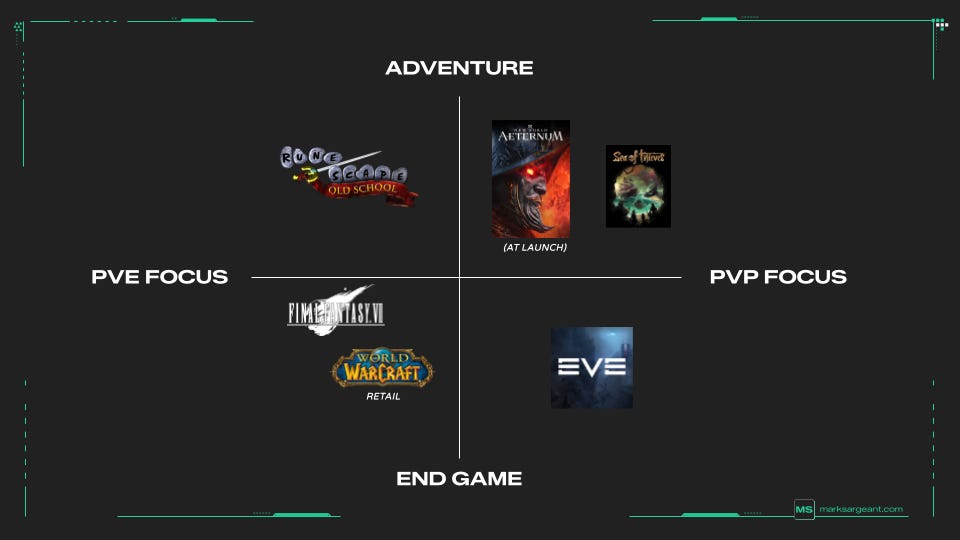
The goal would be to try and identify a potential untapped space. You might need to try a bunch of different potential axes. For example, looking at friction (Hardcore/full loot loss vs. Accessible/Safe) or Economy (player driven sandbox vs dev driven themepark). There’s an endless set of permutations. The team will likely disagree on what the best sets are, and what the definitions should be. One thing I’ve found helpful to guide the selection is that focusing on a set of axes that are going to be highly relevant for your Muse. They should be the axes by which the player often evaluates the space, or “The Mental Ladder” they’ve ascribed to a category or set of games.
Finding your spot on the Mental Ladder
Players effectively categorize games into different parts of their mind. Tactical shooters are over here. Sports games are over there. League of Legends might be so significant it occupies a massive spot, potentially eclipsing even their recognition of other MOBAs.
We can think of these as “mental ladders.” The role of the publishing team is to shape which mental ladder the target audience places the game on, and which spot the game should try to occupy. Ries and Trout argue that for every category, there is a ladder with roughly three rungs:
The Leader: The game that “owns” the category name. Often the first game a player thinks of when a category is mentioned.
The Challenger: Games that are similar to the Leader, but differentiated in a few, select key axes.
The Specialized/Niche: Games that are significantly different from the Leader, often competing for specific sub communities, or have failed to challenge the Leader sufficiently. Games may rest here for a little before falling off entirely.
A game needs to be able to relate to other games on the same ladder, particularly with the leader. One common approach is the “against” strategy. This is where you stop trying to be “better” than the leader and instead try to be “different”, or solve for the leader’s critical pain point.
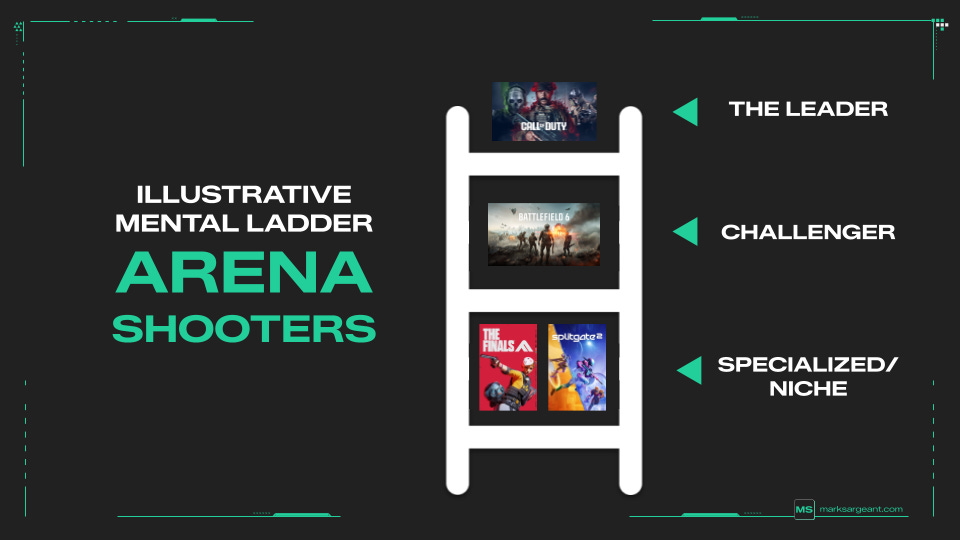
EA’s Battlefield doesn’t try to beat Call of Duty at being a tight, 6v6 arena shooter. Instead, it positions itself against the constraints of the arena. It took an aspect of the leader that works for that audience, but reversed it such that a similar game concept would be appealing to the rejectors. The critical piece here is that as a challenger, the game still needs to relate to the leader, and be comprehensible by others who have Call of Duty at the top of their mental ladder for Arena Shooters.
The “Better Trap” and the Power of the Prototype
The hardest pill for a developer to swallow, and one that might cause an ego bruise - is that being “better” isn’t a winning strategy. In academic psychology, this phenomenon is known as Categorization Theory.
Eleanor Rosch developed the idea of the “Prototype”. This is the most representative member of a category in a person’s mind. When someone says “Hero Shooter”, the brain immediately pulls up Overwatch. This prototype becomes the yardstick against which all other Hero Shooters are measured.
If your pitch is like “we’re like with Overwatch but with better gunplay”, you’ve already stacked the odds against you. You must come across as different, not better to the prototype. Even if you are similar in many aspects. Many players, particularly those already familiar with the original game, aren’t going to switch for something that is only marginally “better”. Being “different” is what is important.
For Marvel Rivals, they picked two key axes to be “different”. First, a focus on a 3rd person perspective, which brought the familiar look and feel of Marvel fan favorite characters to the fore. Having the Marvel IP and deploying it in an immersive and resonant way created a significant “difference” in potential players’ minds. Second, by focusing on a younger, youth audience. By leaning into the creator economy and fandom culture, through prioritizing share of voice in short form content, they positioned the game as a lifestyle and socially salient brand for younger Gen Z. Even the name Marvel Rivals, appears to have targeted the popular FPS Roblox Rivals.
Arc Raiders: The Ladder Pivot
Let’s talk about Arc Raiders. This game is a fascinating example of a “mid-flight” positioning correction. Originally, it was set to be a Free-to-Play co-op horde shooter. But then Helldivers 2 dropped and basically sucked all the oxygen out of that specific room. Embark Studios did something incredibly gutsy: they looked at the “Co-OP PVE Shooter” ladder, saw it was full, or difficult to find a unique differentiated position, and jumped to a different ladder entirely. There were likely other reasons for the pivot, but I suspect this was a significant one.
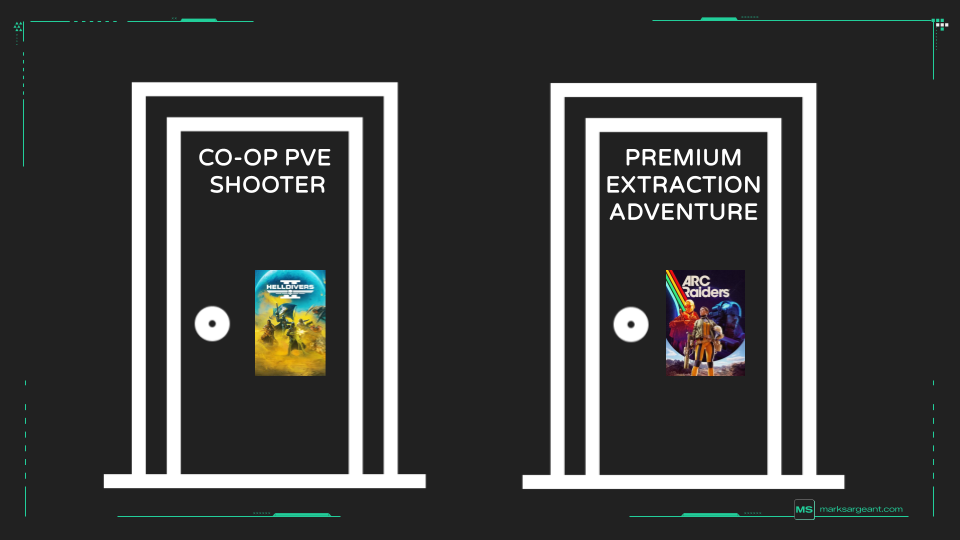
By shifting to a $40 “Premium Extraction Adventure” Shooter, they found a massive, unoccupied gap in the market. On one side, you have the “Hardcore/Sweaty” rung occupied by Escape from Tarkov. With games like Delta Force and Arena Breakout: Infinite, all competing for rungs on that ladder. On the other hand, you have the “Arcade/Shallow” rung of Call of Duty: DMZ. Arc Raiders is aiming right for the center of the “Immersive/Atmospheric” hole. With an appropriate balance of PVE and PVP. They are betting that there’s a huge audience of players who want the high stakes of extraction but are tired of fighting against extremely unforgiving stakes and the mil-sim aesthetic. They aren’t trying to be “The next Tarkov”; they are positioning themselves as the “Accessible-yet-Premium” alternative for the person who wants a gorgeous, immersive world that actually respects their time.
The Niche of One Trap: when you become too exclusionary
Rise and Trout tell you to sharpen your message until it’s a needle. But in publishing games, a needle that is too thin might not carry enough blood to keep a studio alive. There’s a balance to be struck. Or you risk alienating a large potential of your addressable market.
There is a risk of “over-segmentation” and developing a position that’s so specific, something like a “hyper-realistic, permadeath, victorian era underwater city builder”. When your position doesn’t overlap or has appeal with any significant player clusters, you might be positioning for a ghost town.
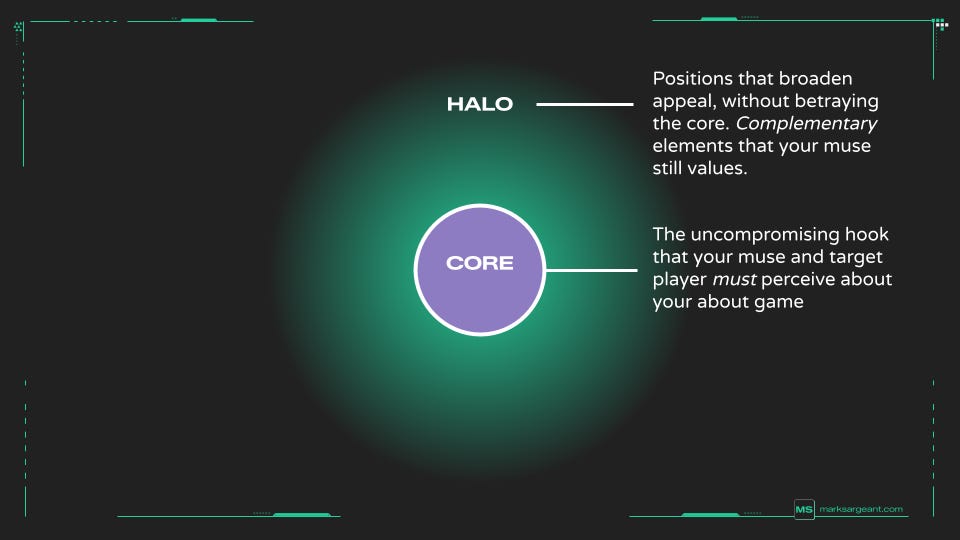
To scale without dulling the needle, one approach might be using a “Core and Halo Approach”. The Core is your uncompromising hook. The thing your muse and target player must perceive about your game. For Elden Ring, the core is “Uncompromising Difficulty”. This is the sharp point that penetrates the “Action RPG” ladder and separates you from the crowd. The Halo would be the positions that broaden appeal without betraying the core. They need to be complementary and things that your target player still values. For Elden Ring, my interpretation of the Halo would be “Open World Discovery”. By wrapping their Core in a Halo, they shifted the game’s position to also be appealing to clusters of players who also value exploration. They kept the needle sharp, but made the needle much, much bigger.
The Law of Sacrifice: The importance of saying no
Even with a Halo, you still have to sacrifice. You have to be brave enough to be “not for everyone”. Dark Souls sacrificed the casual market to own “Achievement”. VALORANT sacrificed mil-sim FPS players to own “Stylish”.
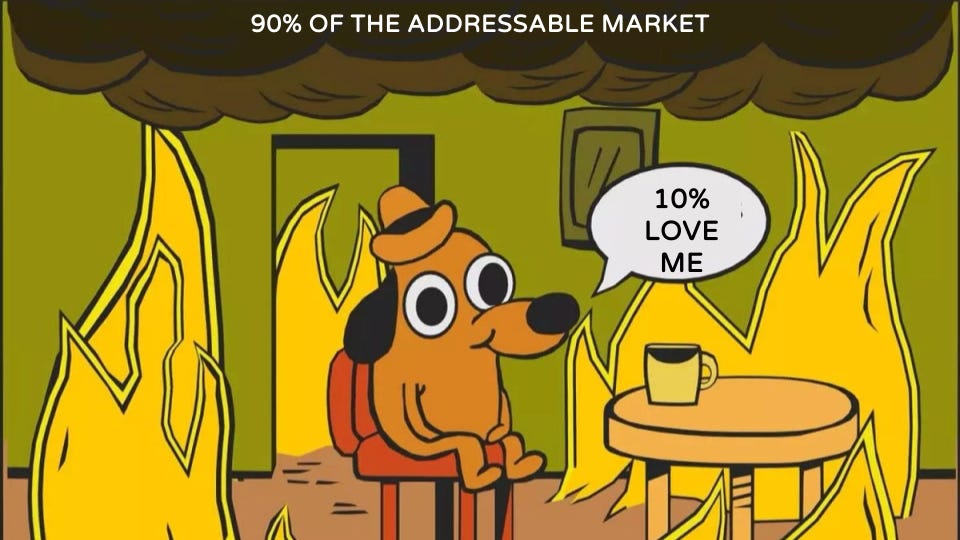
The key is to not sacrifice anything that is fundamental for your target player. By focusing on a representative muse, and fully understanding what’s important to them, you’ll know what sacrifices need to be made. The danger is trying to own spaces that your target player doesn’t care about, this runs the risk of being perceived as “fuzzy”. In an over communicated world, the mind has little room for fuzzy brands. You have to be brave enough to exclude as much as 90% of your potential addressable market, in order to fanatically own the 10% that will love your position. The numbers are illustrative, but you get the point.
Becoming optimally distinct
One of the concepts I’ve found helpful is this idea of being “Optimally Distinct”. You need to be similar enough to the category leader/prototype to be understood, but different enough in one one or two extremely valuable axes for your target audience to be preferred. Stray too far from familiarity and you can’t be understood (e.g. Highguard). But if you don’t differentiate and add novelty in a way that is meaningful for your player, you’ll be labeled generic. Getting this balance right is difficult.
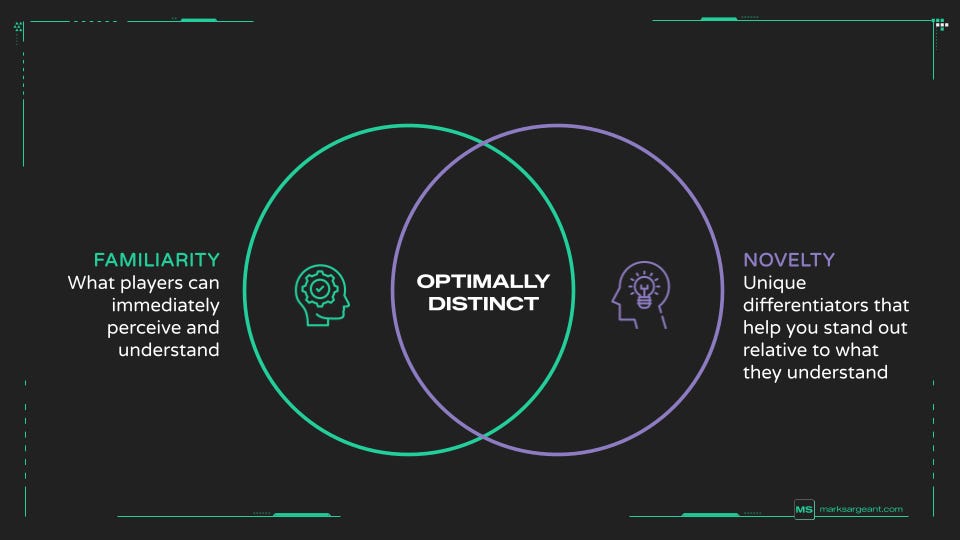
Positioning is a pre-production task. It should dictate what features you build, inform your publishing strategy, and most importantly, what you’re willing to let go of. You can’t market your way out of a “Me-Too” product. You have to position your way into a player’s mind before you even ask them to download your game. The Battle for the Mind isn’t just about being seen; it’s about being remembered for something optimally distinct.

If this resonated, or annoyed you in a useful way, I’ll be writing more about defining your audience, positioning your game, solving for advocacy, AI trends for publishers, and games distribution more broadly.
I’m just here for these gorgeous diagrams.